
San Pablo Resident Lookup Coverage
Each record below confirms a different fact. A deed names parties to a transfer, an assessor roll connects an owner to a parcel, and a court index identifies a case party. None of those alone proves who currently lives at an address. Start with the record that fits the question, then use a second independent source.
| Record | What It Confirms | Where | Access |
|---|---|---|---|
| Assessor or tax parcel | Owner of a specific parcel, situs, tax mailing address, and APN | Contra Costa Assessor and tax channels | Public web entry is limited; counter or request channel for owner data |
| Recorded deed | Grantor, grantee, recording date, document number, and legal description | Contra Costa Clerk-Recorder and RecorderWorks | Free index; copies and certification are fee-based |
| Court case | Indexed party, role, case number, type, filing date, and docket activity | Contra Costa Superior Court | Online civil, family, small claims, and probate information; restrictions apply |
| Vital certificate | Event identity, date, and place, subject to copy type and eligibility | County Clerk-Recorder or CDPH | Informational and authorized copies have different rules |
| Voter status | Authenticated registration status and election geography | Contra Costa Elections or California Secretary of State | Identity-gated; not a public name browse |
| Permit or code case | Address, project or case description, dates, and displayed contacts | San Pablo eTRAKiT | Free public search; transaction tools need an account |
| Probate or obituary | Decedent, relatives, dates, and sometimes a historical address clue | Superior Court, CCCHS, and newspapers | Recent court material and historic index channels differ |
| Business or professional license | Entity, agent, business address, license status, or discipline | bizfile, DCA, county FBN, or city records | Business presence is not residence proof |
The table also shows why a San Pablo resident lookup should not be reduced to an address list. Public information can be stale, hidden, or tied to a different role. Save the source, date, and record number for every match.
Build a San Pablo Identity Matrix
The same-name trap is local and practical. A common name plus San Pablo is weak evidence. A middle initial, spouse or relative, date range, parcel, case number, and matching source can make a record comparison stronger. The matrix is a short worksheet that keeps facts separate from assumptions.
- Write the exact name and every known spelling, middle initial, married name, compound surname, or abbreviated form.
- Add the narrowest known time range, address, ZIP, parcel, relative, organization, or event location.
- Search the record that answers the main question, such as a court party index, deed, probate file, license, or obituary.
- Record the case number, document number, APN, filing date, recording date, or source page instead of copying only a name.
- Seek a second overlap from a different record family. Two independent matches are a safer threshold than a city name alone.
- Mark a conclusion as a clue when the record shows an owner, business contact, mailing address, or historical appearance rather than a current household.
Do not ask a clerk to confirm an identity theory by phone. Ask which index, file number, copy type, or custodian applies. The record holder can explain access; the researcher must keep the comparison honest.
Search a Contra Costa Court Party
The exact Contra Costa court portal is https://kiosk-cacontracosta.tylertech.cloud/Portal/. It covers civil, family, small claims, and probate information. A San Pablo case goes to Contra Costa Superior Court because San Pablo has no municipal court. The portal is a party and case index, not a complete file room.
| Search type | Party or name, case number, and available category modes. |
|---|---|
| Party name | Name fields accept variants; results depend on division and visibility. |
| Case number | Exact-number lookup when a filing or notice supplies it. |
| Case category | Civil, family, small claims, or probate filter where available. |
| Search and Reset | Run or clear the selected query. |
The Superior Court party-search source is also the source for the court result screen below.
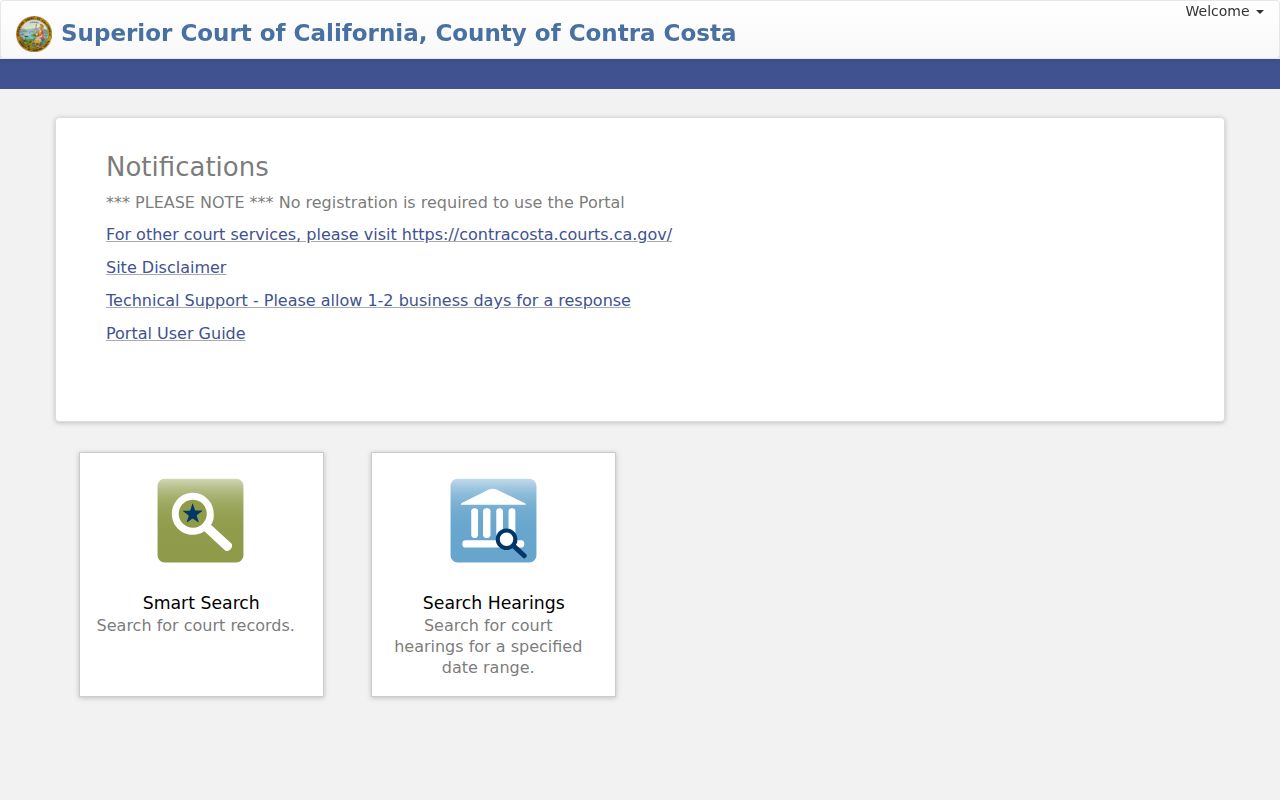
The court image shows why a name result is only the start of a San Pablo resident lookup. Check case type, party role, date, and status before treating it as the right person.
Criminal case information, criminal documents, orders, and minutes are not online through this portal. Juvenile, adoption, sealed, protected, and confidential family matters can also be absent. Addresses for self-represented parties are withheld online. A missing result does not establish that no case exists.
Read a San Pablo Court Result
A court search result is an index record. It can point to a file, but it is not the same as a certified copy or a finding about a person's present address. Keep the visible fields together and note which details are unavailable.
- Case number: the stable identifier for a court file.
- Case caption: the styled case name, which may abbreviate parties.
- Party names and roles: the listed position in the case, not a household relationship.
- Case type and filing date: the division and the start of the indexed matter.
- Status: the current or last displayed case state.
- Docket or register events: dated entries that show filings or actions when visible.
- Document availability: access varies; online absence can reflect confidentiality or a portal limit.
For a file at the counter, Court Records is at Wakefield Taylor Courthouse, 725 Court St., Room 103, Martinez. The mailing address is P.O. Box 911, Martinez, California 94553. The office is open Monday through Friday, 8 a.m. to 4 p.m., and the phone is 925-608-1000. Valid identification is required to view a file. Mail requests need a self-addressed stamped envelope.
Copies are $0.50 per page. Certification is $40 plus the page charge. A certified divorce judgment is $15 including copies. Richmond and Pittsburg branches can supply some electronically stored small-claims records. Ask for the file by case number and verify whether the needed item is a copy, a certification, or a clerk lookup.
Note: A court index can confirm a case party without revealing a self-represented address or every document in the file.
Vital Records and San Pablo Lookup Rules
California does not use a simple age rule that opens every birth or death record. Health and Safety Code sections 103526 and 103526.5 distinguish authorized certified copies from informational copies. An informational copy can carry the legend “INFORMATIONAL, NOT A VALID DOCUMENT TO ESTABLISH IDENTITY.” Authorized copies are limited to statutory relationships and roles. Confidential marriage copies are restricted under Family Code section 509.
| Record | Custodian and rule | 2026 CDPH fee |
|---|---|---|
| Birth | County event record or CDPH statewide copy; informational and authorized choices | $31 |
| Death | County or CDPH; access depends on copy type and eligible relationship | $26 |
| Marriage | County that issued the license or CDPH; confidential copies go to spouses or court-authorized requesters | $19 |
| Dissolution | Superior Court supplies the judgment; CDPH supplies a limited Certificate of Record for divorces registered 1962-June 1984 | $18 |
The California vital-records source states that direct CDPH requests are mail-only as of July 1, 2026. Mail CDPH-VR, MS 5105, P.O. Box 997410, Sacramento, California 95899-7410; phone 916-445-2684; email VitalRecordsHelp@cdph.ca.gov. Mailed authorized requests require a notarized sworn statement on VS20, and orders are final with the search fee retained when no record is found.
Voter Status Is Not a Street Directory
Contra Costa My Voting Information and the California Secretary of State voter-status tool are identity-gated. They are useful for an authenticated voter checking their own status and election geography, but they are not a public browse by name or street. Elections Code section 2194 generally treats registration information as confidential and controls permitted release. Section 18109 makes unauthorized voter-data use a misdemeanor.
A voter-file application can involve the applicant and beneficiary names, contact details, organization, authorized purpose, file scope, format, specific-voter details, identification, agreements, and a signed certification. Statewide data costs $15 per 1,000 records, with a $15 minimum and $100 maximum. A specific-voter request costs $30 per person, up to ten people and $100. Contra Costa's current county-specific data fee was not published on the inspected page. Historical registers and poll books require an Elections, State Archives, or History Center inquiry.
Registration status can change after move notices, returned mail, or a statutory confirmation process. An active, inactive, or cancelled label is dated evidence. It does not prove who occupies a parcel, and ballot selections are never disclosed.
Probate, Obituaries, and Adoption Paths
Probate and obituary sources serve a different human use: tracing an heir, clarifying a family timeline, or understanding why a name disappears from a local record. Recent probate belongs with Superior Court. Historic decedent indexes, obituary clippings, naturalizations, and local cases are available through CCCHS channels. The Historical Society index can supply a lead, while a court file or newspaper image supplies the underlying detail.
Adoption searches must use California's official Mutual Consent Program. CDSS Form AD 902 lets an adult adoptee age 18 or older and a birth parent consent to exchange email or phone contact when both consents exist. For qualifying post-1984 adoptions, Forms AD 908 and AD 908A can support disclosure under statutory conditions; an adoptee seeking a name or address must be 21 or older. CDSS does not solicit consent and does not operate an open name search.
A probate name, obituary, or adoption consent is not a shortcut to a current address. Keep the record's date, role, and source, then seek the next lawful custodian if a current fact is genuinely needed.
San Pablo License and Business Clues
A professional license or business entity can distinguish two people with the same name, but a business address is not residence proof. The California Department of Consumer Affairs search uses Board or Bureau, License Type or Number, Business, First Name, Last Name, and Registry Number controls. Results show status, expiration, and public discipline where available. The DCA license search is free.
The DCA search source supports this San Pablo resident lookup check.
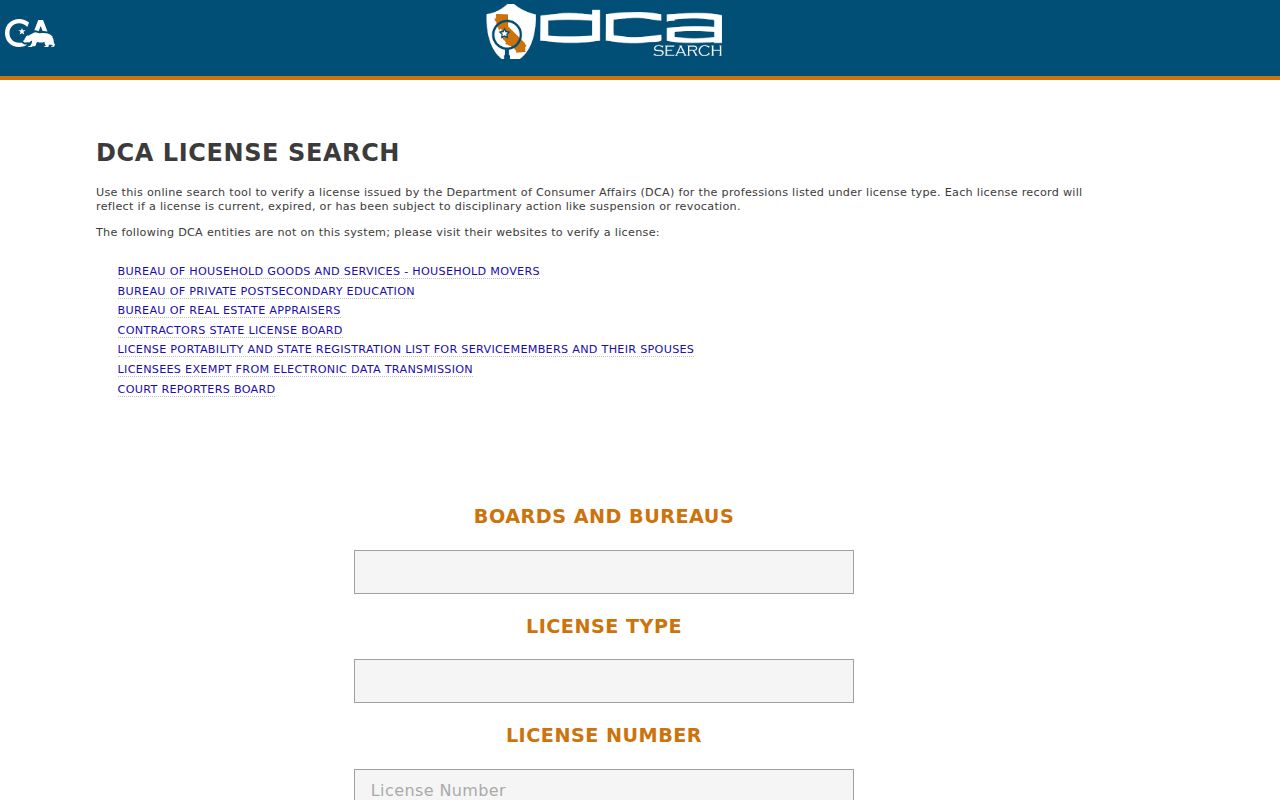
The DCA result is a professional-status clue. Use the name, license type, city, and status together, and keep the record date.
California Secretary of State bizfile Online searches by entity name or file number, with advanced controls for entity type, status, initial filing dates, and Begins With matching. Basic results can show formation, status, jurisdiction, addresses, agent, filing dates, and recent PDFs. Bizfile does not supply ownership, EIN, phone or email, subsidiaries, or internal agreements. San Pablo's city eTRAKiT business-license module is a separate local layer.
The official bizfile search is the source for the business-entity step.
Business records can anchor a name to a public role or entity. They still need a second record before they are treated as a person match.
Owner, Occupant, and San Pablo Address Clues
The Contra Costa Assessor prepares the annual roll and keeps parcel maps, but public web tools suppress owner names because protected-address suppression cannot be reliably maintained online. The Assessor counter or request channel is the fallback for assessed ownership. CCMAP can show a site address, APN, deed reference, recording date, values, exemptions, year built, area, and parcel map links. It does not show an owner or mailing address in the public popup.
A tax mailing address can differ from the situs address. A deed names grantors and grantees to a transfer. A permit names a project, applicant, contractor, or displayed contact. A voter tool describes an authenticated registration status. These roles overlap sometimes, but none is a complete household roll. Note the source role beside every address in the identity matrix.
For city records, San Pablo eTRAKiT searches permits, Planning/RHS, business licenses, and code cases without login. Login is needed for applications, uploads, and payments. Search results may expose a project address, status, dates, scope, and displayed contacts, subject to redactions.
DROP and Safe at Home Change the Trail
California privacy programs explain why a careful San Pablo resident lookup can end without a visible address. The California Consumer Privacy Act, Civil Code sections 1798.100 and following, gives covered consumers rights to know, access, delete, correct, opt out of sale or sharing, and limit sensitive-information use, with exceptions. Information lawfully available from government records is excluded from the CCPA definition of personal information, so a broker deletion does not erase a deed or assessment roll.
The DELETE Act created DROP, the state's centralized deletion request. California reported more than 225,000 enrollments in its first six weeks, reaching more than 500 registered brokers, with brokers beginning processing on August 1, 2026. Use the official DROP portal, verify California residency, select identifiers, save the confirmation, and recheck later because public facts can be reacquired.
Safe at Home provides a substitute mailing address and confidential forwarding for eligible survivors of domestic violence, stalking, sexual assault, trafficking, child abduction, elder or dependent-adult abuse, and certain threatened public or reproductive-health participants. It does not erase historic records. Proper nondisclosure demands can restrict public display of a participant's home address and phone.
Note: A protected address may be absent by design, so do not fill the gap with a guessed household match.
Lawful Limits for a San Pablo Resident Lookup
Public records are for personal, lawful research, family history, civic understanding, and record verification. California Penal Code section 646.9 addresses stalking through repeated following or harassment with a credible threat and fear; Code of Civil Procedure section 527.6 provides a civil-harassment process. Voter-data misuse, protected-address exposure, and misuse of law-enforcement or registry information can carry separate consequences.
Lawful use. A San Pablo resident lookup should never be used to stalk, harass, intimidate, threaten, or expose someone who has a confidentiality protection. Verify with the actual custodian and stop when the lawful question is answered.
When a record is wrong, contact the custodian that created it and ask about its correction, copy, or redaction process. When a search is simply incomplete, preserve the gap as a gap. That is more accurate than merging an owner, a case party, a business contact, and a historical directory entry into one person.