
Finding Residents in San Pablo Records
San Pablo has no master roll of who lives where. A useful residents directory is a set of clues. Different custodians hold different slices. The city keeps permits, planning and Residential Health and Safety cases, business licenses, code cases, staff contacts, and its own public-record request files. Contra Costa County holds assessment, deed, election, court, and vital records. For the older household layer, turn to the library, the newspapers, and the History Center. Start with one question you can state clearly, whether that is who owned a parcel, who registered at an address, or which office can answer a focused request. Clarity saves a trip.
A property record names an owner. The household behind that owner is a separate question. Tax mailing addresses sometimes differ from situs addresses. Voter rolls sit behind an identity gate rather than a public street browse. A deed dates a transfer, not a move-in. Because of these gaps, a San Pablo residents directory search works best when each result carries its record date, source, and limits.
- Check the USPS address result and the city's incorporated-boundary map before choosing a custodian. A San Pablo mailing address can sit outside the city.
- Use the County Assessor and CCMAP to identify the parcel, APN, situs, values, and deed reference. Treat the mailing address as a separate field.
- Use RecorderWorks for the indexed grantor, grantee, document type, date, APN when available, and legal-description trail.
- Use the city's eTRAKiT search for permits, planning or RHS, business licenses, and code cases when the parcel is inside San Pablo.
- For a person or household question, compare court, voter-status, vital, business, newspaper, directory, or probate evidence, then ask the custodian for the missing record.
Sometimes an address is the only clue you have. The San Pablo street-directory walkthrough keeps the parcel, deed, permit, and household layers in the right order.
Where San Pablo Resident Records Stay
City Hall is a starting point for municipal evidence, not for every record carrying a San Pablo address. The City Clerk takes California Public Records Act requests three ways. NextRequest handles them online. Mail goes to City Clerk, 1000 Gateway Avenue. Email works too, at CityClerk@SanPabloCA.gov. A focused request should name the record, date range, department, and address or APN, and the city's initial determination can take up to ten days, with inspection sometimes arranged instead of copying.
The durable trail sits in Martinez. The Clerk-Recorder keeps recorded documents and vital certificates. The Assessor keeps the annual roll and assessment maps. Elections controls registration information, and Superior Court keeps local case files. The Public Records Act offers a path when an index is missing, though privacy, privilege, and other confidentiality laws still control what may be disclosed.
Contra Costa Assessor
2530 Arnold Drive, Suite 100
Martinez, CA 94553
925-313-7400
San Pablo Jurisdiction Before a Resident Search
Geography comes first. USPS draws delivery territory, while San Pablo draws an incorporated boundary. The two do not match. ZIP 94806 reaches past the city into unincorporated pockets. The city names Rollingwood, Tara Hills, Bayview, and Montalvin as places that may carry a San Pablo mailing name without being city parcels. A request sent to the wrong office can look like a missing record when the real issue is the boundary.
Check the address with USPS address lookup, then compare it against the city's incorporated-limits map. Inside San Pablo, eTRAKiT is the useful municipal path. Outside it, in Richmond or unincorporated Contra Costa County, the permit, code, planning, and police custodian may change. The step is small. It matters anyway. It keeps a San Pablo resident directory search from mixing city and county evidence.
San Pablo Property Search Fields and Limits
The County Assessor prepares the annual assessment roll and maintains more than 12,000 assessment maps. The public web entry leads to property resources. Owner names are another matter. Contra Costa suppresses them from online property tools because protected-address suppression cannot be kept current there. Ownership stays public through Assessor counter and request channels. CCMAP can bridge an address to a parcel, but its map is not a certified ownership record.
| APN | A ten-digit parcel number arranged as map book, page, parcel, and final digit. |
|---|---|
| Situs | The physical property address or legal description tied to the parcel. |
| Assessee as of Jan. 1 | The tax-roll owner field for the assessment year, not a current household field. |
| Tax mailing address | Where assessment correspondence goes; it may differ from the San Pablo situs. |
| Value and exemptions | Assessed value, net taxable value, tax-rate area, and property messages. |
For a parcel-level clue, record the APN, year built, values, exemptions, deed reference, and recording date from CCMAP. A homeowner exemption hints at owner occupancy. It proves nothing about who lives there. The next step is the recorded document or an Assessor counter inquiry, not a guess from the tax mailing address.
Trust the county's own entry. Open the official Assessor page before relying on any online result, since the County Assessor's public property entry is the source for this screen.
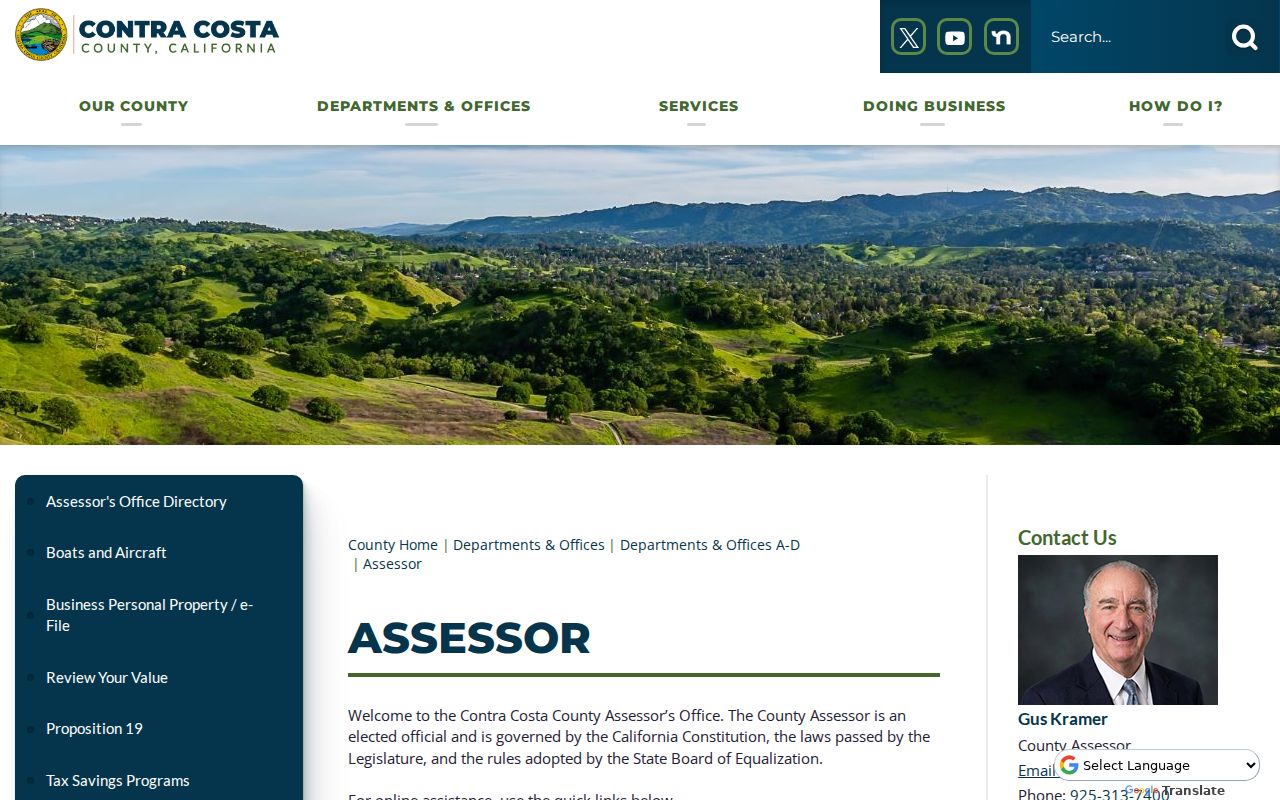
The county page lays out its property entry route. The counter and request path still matters for owner fields the web tools leave blank.
San Pablo Sources for Current Residents
These sources overlap. They do not answer the same question. One name can mean several things. The strongest San Pablo residents directory practice labels each entry as owner, party, registrant, permit contact, city employee, business connection, or historical occupant rather than calling every name a resident.
| Source | Who It Lists | Keeper | Access |
|---|---|---|---|
| Assessment roll and CCMAP | Parcel, APN, values, tax mailing, deed handoff | Contra Costa Assessor / GIS | Web map plus counter/request fallback |
| RecorderWorks | Grantors, grantees, dates, document types, legal descriptions | Clerk-Recorder | Free index; copies ordered separately |
| Voter-status tools | Authenticated status and election geography | County / California Secretary of State | Identity check or permitted file request |
| eTRAKiT | Permit, planning/RHS, license, and code case activity | City of San Pablo | Free public search; account for transactions |
| City staff directory | Official role, department, email, and direct phone | City of San Pablo | Free online browse |
A city staff directory lists public roles, not households. The same caution fits a business address, a court party, or a property owner. Searching for one person in San Pablo takes a different path. Searching for a parcel is a separate task. Use the dedicated current-record workflow and keep dates beside each source.
Official San Pablo Records Versus Compiled Profiles
Official records and commercial compilation tools do different jobs. A county index, city portal, court clerk, library, or state program tells you who created an entry. It also shows what date it carries. And it explains how to request a correction or certified copy. A commercial compilation can merge phone, marketing, property, and other data into one broad profile. That match may be stale or simply wrong. The records office that holds the original entry remains the place to verify it.
| Channel | Useful For | What To Verify |
|---|---|---|
| Government or library source | Named record series, date, custodian, access rule | Jurisdiction, record date, copy type, and redactions |
| Commercial compilation category | A lead that may point toward a record | Name match, freshness, source, correction and opt-out path |
Compiled profiles can still help with San Pablo family history, heir work, address research, or scam avoidance. Treat the profile as a prompt to locate the official source. Never treat it as proof of a current household.
San Pablo Permit Records by Address
San Pablo eTRAKiT is the most local address-keyed search surface available. Its landing page separates Permitting, Planning/RHS, Business License, and Code Enforcement. Public record search needs no login. An account is needed to submit an application, upload plans or documents, and pay fees. Results can connect an address to a permit number, type, status, application and issue dates, work description, applicant or contractor, and inspection activity, subject to redactions.
| Module | Permitting, Planning/RHS, Business License, or Code Enforcement. |
|---|---|
| Search By | Portal-specific choice such as permit, project, case, address, parcel, contractor, or applicant where exposed. |
| Search text | The number, address, parcel, or name matching the selected mode. |
| Date range | A date pair where the selected module exposes one. |
| Result tabs | Permit Info, Site Info, Contacts, Fees, Inspections, Chronology, Conditions, and Reviews. |
Issued permit lists begin in 2018, and finaled lists begin in 2020. Code Enforcement, created in 2002, covers abandoned vehicles, vacant or dilapidated buildings, fire hazards, environmental crimes, and street-sweeping enforcement. Those records help date activity at a site. But a permit contact or code case does not establish a household. The city portal hosts the search modules. View San Pablo eTRAKiT for the live search path.
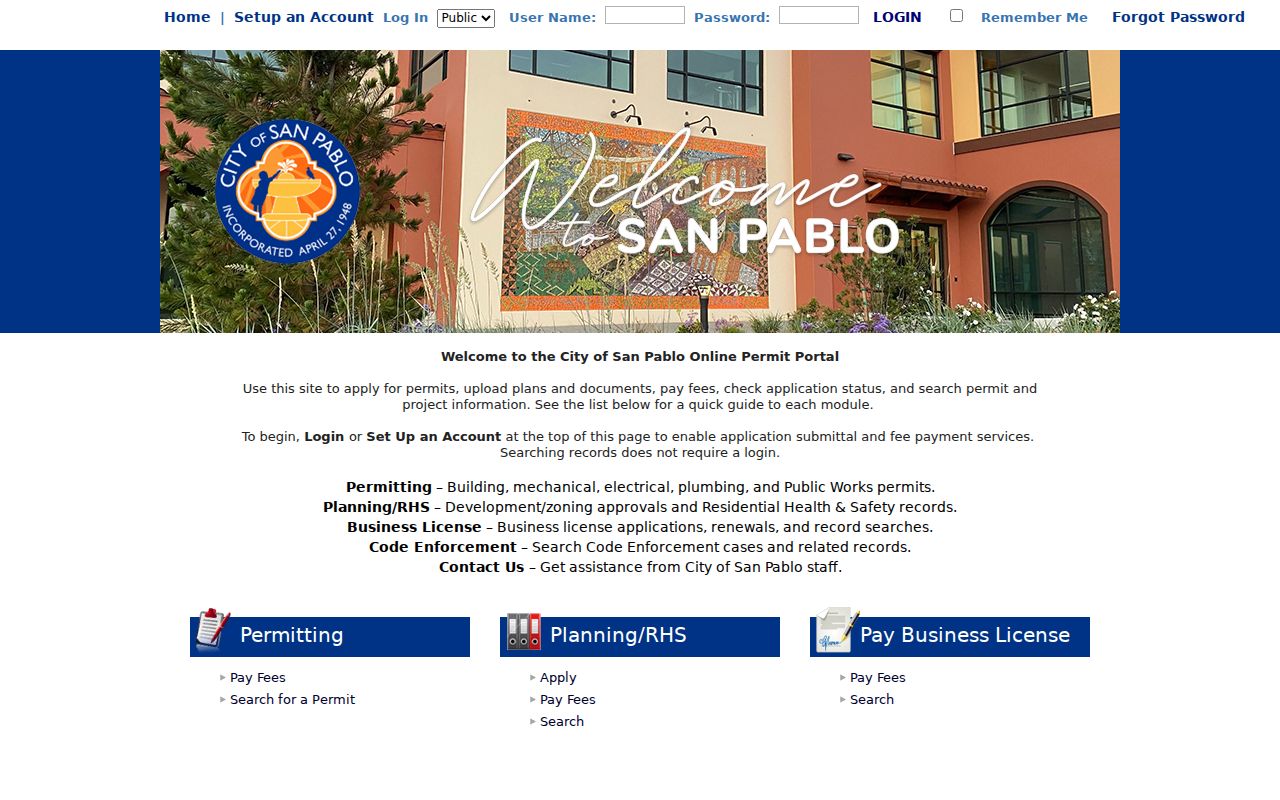
Use the address as a date anchor. Then compare a permit result with parcel and deed evidence rather than treating the contact list as a resident list.
Matching One San Pablo Name Across Records
A name-only result is a lead, not an identity. Common names can create false deed matches, and court portal visibility varies by division. Build a small identity matrix before joining records. It should include exact and variant name, middle initial, approximate date, address or APN, spouse or relative, business link, and record number. Require two independent overlaps before treating entries as one person. One example is the same name plus address across a deed and a directory.
- Roll
- An official list, such as an assessment or registration list, created for a defined public purpose.
- Index
- A finding aid with names and reference fields; the underlying image or file may require a separate request.
- Parcel
- A mapped unit of land with an APN and legal description, not a list of the people who occupy it.
- Criss-cross directory
- A historical address-order section that can connect a street location to an adult or householder entry when that volume includes one.
Spanish compound surnames, married names, initials, Anglicized given names, and OCR errors all matter in San Pablo research. A tax mailing address should not be merged with residence. Keep a business or license address labeled as business evidence.
San Pablo Court and Vital Record Paths
San Pablo has no municipal court for this search. Local trial matters go to Contra Costa Superior Court. Federal cases go to the Northern District of California and PACER. The county court portal covers civil, family, small claims, and probate information. Criminal case information, documents, orders, and minutes are not online in the same way. Self-represented party addresses are withheld. Vital certificates follow a different rule. California distinguishes authorized and informational copies rather than opening every record after one fixed age.
| Question | Best first source | Key limit |
|---|---|---|
| Case party or docket event | Contra Costa Superior Court | Sealed, juvenile, adoption, and protected matters are unavailable. |
| Birth, death, or marriage event | County Clerk-Recorder or CDPH | Copy type and statutory eligibility control access. |
| Federal party or case | Northern District / PACER | Federal system, fees, and document access differ. |
The California Public Records Act permits an identifiable request without explaining the reason. Confidentiality exemptions still apply. Ask for inspection when that is enough. Keep a clear record series, date range, address or APN, and preferred format. When the Superior Court index is not enough, Court Records serves files at Wakefield Taylor Courthouse. It sits at 725 Court Street, Room 103, Martinez, Monday through Friday, 8 a.m. to 4 p.m. Valid identification is required. Mail requests need a self-addressed stamped envelope. Copies or certification are charged by the court. Federal matters move to the Northern District of California and PACER. County vital certificates use their own forms, eligibility rules, and mail channels. California Department of Public Health applications do too.
San Pablo Voter Status Is Not a Resident Directory
Contra Costa My Voting Information and the California Secretary of State status tool require identity fields such as first name, last name, date of birth, and a portal-dependent identification fragment. They support an individual status check. They are not a casual name or street browse. Elections Code section 2194 restricts registration information, and section 18109 addresses unauthorized use. A permitted voter-file request must identify the applicant, beneficiary, purpose, scope, format, identification, agreements, and certification. A voter record may contain residence or mailing address, party preference, status, registration date, precinct, districts, and participation history, but never ballot choices. Active, inactive, or cancelled status is dated evidence affected by list maintenance. Safe at Home participants receive confidential handling. An absent result is not proof that someone is absent from San Pablo.
Tracing San Pablo's Historical Resident Directories
San Pablo's old directories ride along with Richmond imprints. The city sat in West County publishing territory. A Richmond historic-context bibliography verifies R. L. Polk & Co.'s Richmond, San Pablo and Martinez Directory for 1912-1913. Later Richmond city directories sometimes carry San Pablo-area entries, though the complete year-by-year run never went online. Confirm holdings before any visit. A 1952 Chinese business directory covering San Pablo is cataloged at UC Berkeley's Bancroft Library under call number F870 .C5 C36 1952.
Newspapers bridge the years between directory imprints. The San Pablo Bee ran from 1923 to 1950, the San Pablo News from 1950 to 1980, and The News from 1980 to 1982. San Pablo entries lean on Richmond publishing for one plain reason: incorporation came on April 27, 1948, after a 1,437-838 vote against annexation. For a shelf-by-shelf route through these holdings, use the San Pablo city directory collections page.
San Pablo's History Center Fills Web Gaps
A dead-end web index sends many searchers to the Contra Costa County History Center. Its shelves run deep. Annual assessor books cover 1850 through 1910. More than 1,700 maps sit beside city layouts, tax maps, landownership maps, newspapers, directories, naturalizations, probate indexes, and obituary clippings. Court records run through 1911 in physical form. Some series reach into the 1950s. Indexed cases top 9,300, naming more than 61,000 people. Naturalizations alone span 1850-2008 in 107 volumes and more than 13,000 cases.
The center sits at 724 Escobar Street in Martinez. The PACT terminal there is free. Staff research runs $20 per hour for members and $30 for nonmembers for personal use. Remote inquiries start by email, phone, mail, or web form, with a free initial consultation and a quote before work begins. Book ahead for older fragile maps. Ask here for a pre-digital San Pablo clue that no county portal exposes.
City-held records take a different path through San Pablo's municipal request system. Open San Pablo NextRequest when the missing item belongs to the city rather than the county.
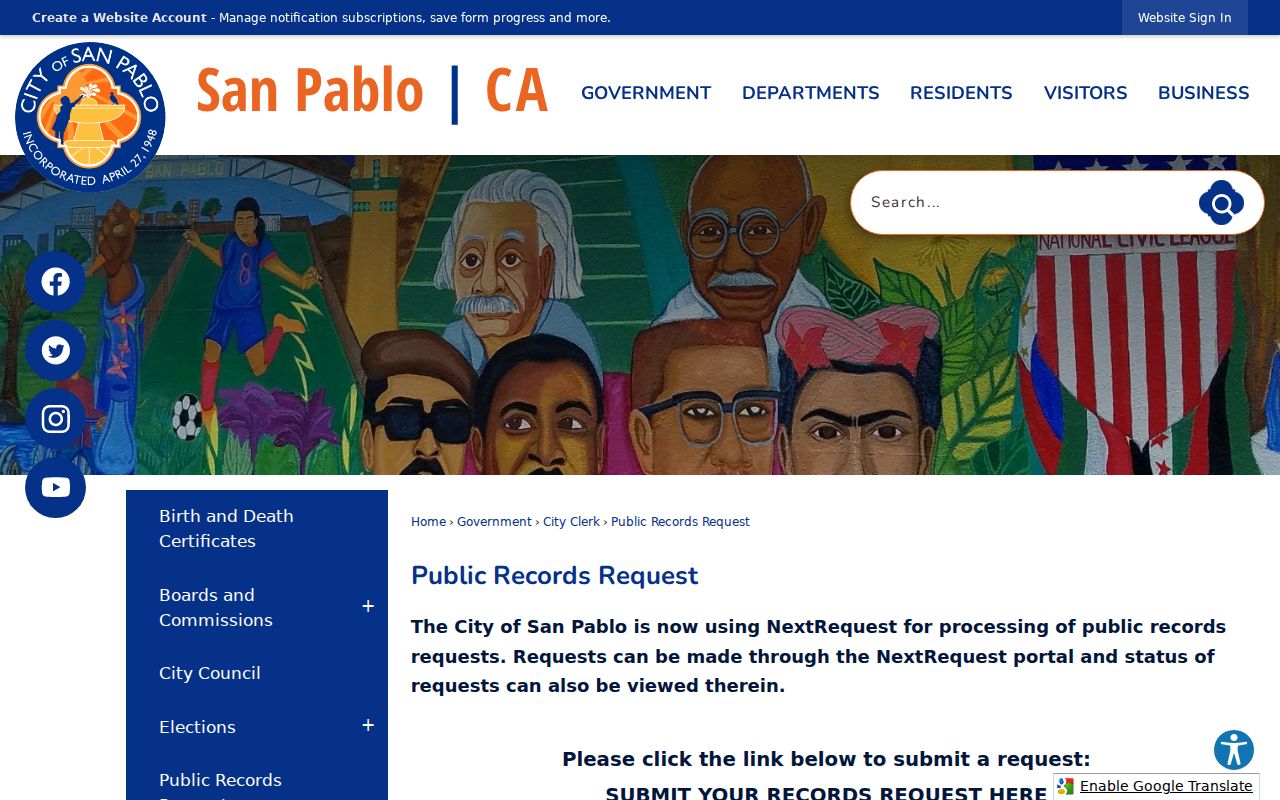
City-held material belongs in a city request. Records held by the county or the History Center take the other route, so aim each inquiry at the right custodian from the start.
Privacy-Safe Ways to Research San Pablo Residents
A responsible search respects the line between public records and private life. California Safe at Home offers a substitute address plus confidential mail handling for eligible survivors and certain threatened participants. It does not erase historic deeds. The state DROP program works differently. It sends one encrypted request from a resident to participating data brokers, but it cannot delete a deed or assessment roll a government custodian must keep. For a city record, file a focused CPRA request. Old family trails point elsewhere. Use the library, newspaper archives, or the History Center rather than a broad hunt for a living household.
Lawful personal use. San Pablo records can support genealogy, heir work, address history, civic curiosity, and scam avoidance. Do not use a name, address, voter record, court result, or registry entry to stalk, harass, threaten, or intimidate anyone. California stalking and civil-harassment laws apply even when a record was easy to find.
Results can look wrong. Take it back to the custodian. Ask about the date, the index convention, the correction process, or any access limit, since a labeled partial result beats a confident but unsupported claim about who lives at an address in San Pablo.